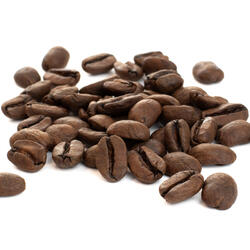


Brazil Minas Swiss Water Decaf – Roasted Coffee

You may have tasted Brazilian coffee before, perhaps from the traditional Sul de Minas region. How about trying it decaffeinated this time? A gentle Swiss method has removed the famous alkaloid from the coffee but has preserved its naturally excellent taste and aroma. Your cup will brim with the flavors of chocolate and nuts, offering a sweet, balanced, and fragrant experience. You can indulge as often as you desire.
Shipping methods
| Nizozemská pošta HD - zásilkovna | Delivered by 22. 10. | 1,00 € |
|---|---|---|
 DHL DHL |
Delivered by 22. 10. | 4,90 € |


Ingredients
100 % ArabicaTaste & Crema
The Minas Swiss Water Decaf coffee beans from Brazil are full-bodied, balanced, and smooth, with flavours including chocolate and nuts. A long and pleasant aftertaste remains on the palate for several minutes, which is guaranteed to delight any coffee drinker. The crema is sure to please as well, being smooth, light, and compact.
Origin of the coffee

Sul de Minas lies,as the name suggests, in the South. More precisely, in the South of Brazil's Minas Gerais region, typical for rolling hills, mild climatic conditions, and the kind of rainfall that coffee plants thrive on. Although this area has the largest coffee plantations in Brazil, more than half of the farms are managed by small farmers. For generations, they have tended 10-150 hectares of fields, often producing special local microlots. We present coffee beans of the bourbon variety, one of the most culturally and genetically important varieties of Coffea arabica in the world. Although it has relatively low production and it's susceptible to disease, it is known for its excellent flavor and aroma, which its seeds acquire mainly by ripening high in the mountains. French missionaries gave it its name in the early 17th century, and for 200 years, it was grown exclusively on the island of La Réunion (formerly Bourbon). It was not until later missionary journeys that they spread these coffee plants to Africa and America.
The high-quality beans have been decaffeinated this time, so the people with high blood pressure, sleep problems, pregnant women, or nursing mothers can enjoy the taste of real Brazilian coffee. How has the world's most widespread stimulant been removed from coffee? By the so-called Swiss method. But first, we will describe the harvesting and processing of coffee cherries.
From June to September, workers head to the plantations to hand or machine-harvest the coffee plants. Most farms in Brazil harvest the berries using machines resembling a kind of rake, whose ''fingers'' are driven by a motor. Harvesting is thus gentle, quick, and cheap (the current labour market situation in Brazil is not favorable). In addition, the workers spread large tarps between the trees, from which the fallen cherries are easily removed. If they remain on the ground among the coffee trees, they attract insects and pests of all kinds. The harvested fruit is transported to processing farms, stripped of its skin, and fermented, and the loose beans are dried using the so-called washed method.
The certified Swiss Water process is used to remove the caffeine. The green coffee beans are immersed in hot water, and the caffeine is extracted using activated carbon filters. The coffee stays in the water for 10 hours while constantly filtering and maintaining the necessary temperature. Repeating the process loses most of the caffeine, so the resulting coffee contains less than 0.01%. The undeniable advantage of the Swiss method is that it uses no added chemicals, and the water that remains at the end is returned to nature when the coffee plants are irrigated.
Benefits of coffee


Coffee packaging preview
Our quality aluminum packaging lacks any bold graphics, as we’d rather focus on the taste of our coffee. It always comes fresh thanks to degassing valve, which releases the gases that occur after roasting. Thanks to the hermetic seal, this container helps the contents further keep their freshness and protect them against humidity, light or foreign odors.
Instructions for preparation
Grind your coffee according to your preferred method.
Use 14ml of water per 1g of coffee. For 1 cup of coffee use 7g.
Add your coffee and pour over with boiled water (95°C).


Are you looking for inspiration? Other customers have bought this:
Brazil Santos NY2 SSFC 17/18 – Roasted Coffee
Cuba Serrano Superior – Roasted Coffee