


Why our products?
- Free shipping on orders over 49 €
- Satisfied customers
- Delivery date is specified within the product description
Fine or coarse? How to actually grind roasted coffee
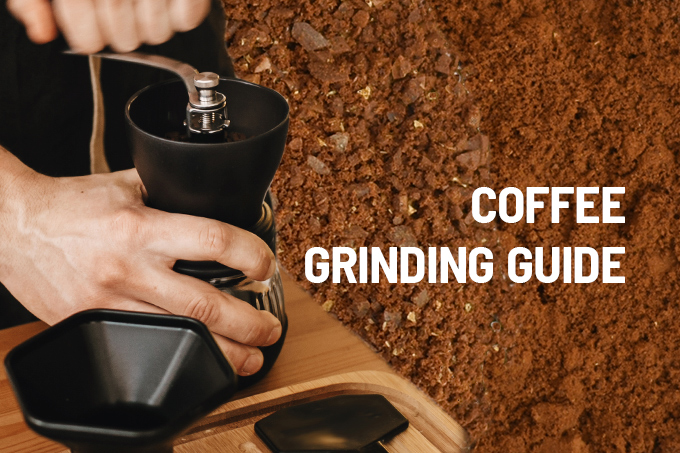
The coffee you bring home has already gone through most of the processing: it has been cultivated in the sun-kissed fields, gently harvested and roasted with careful attention. All the stories and secrets of its conception are already hidden inside – and it offers us a uniquely delicious moment with a cup made from it.
Despite all that, though, it’s you who has the final say in it the quality and taste. The most important part of preparing coffee is deciding how you’re going to do it – whether you choose the right coarseness and method that can bring forth all of its amazing qualities and hidden layers.
Grinding your coffee
Before coffee was used to make a beverage, people were chewing on its tiny, cherry-like fruits to boost their energy. Once people began roasting coffee, they also started looking for ways to grind it into the fine powder we’re familiar with today. At first, roasted beans were ground between two flat stones, similar to wheat. Soon, this developed into mortar and pestles made out of stone or wood, but this method was slow and tiring and ground coffee produced this way was inconsistent and too rough.
Still, the first machine for grinding coffee – a simple tool with a hand-crank – didn’t emerge until many years later. First coffee grinders were robust, often used to grind more than coffee; produce such as wheat, corn and more. Coffee-exclusive grinders appeared only after more technological development and they were not only smaller, but also way easier to use. Maybe you even own one of them, inherited it from your grandparents or picked it up as a curiosity in an antique store. It has a tiny drawer, where your ground coffee ended up once you spun the handle. Do you still use for it from time to time, or are you more inclined to reach for coffee that’s already been ground?
The beauty of freshly roasted coffee is often shadowed by modern convenience. It was replaced in favor of fast, easy coffee pods or automatic coffee machines that already have a built-in grinder. More often than not, coffee is meant for a quick break to regain some of your energy and then move on as fast as possible.
Today, let’s take a break and recall the lost art of grinding your own coffee. Just because we can. Or maybe to remind you that there’s much more to your morning cup than you previously thought.
Whole or ground? Which is the best for you?
If we asked true coffee lovers whether to shop for ground coffee or rather look for whole roasted beans, they will definitely insist on the latter. Ground coffee, once unsealed, tends to quickly lose its aroma and intensity. All it takes is a few hours in the open and the coffee will inevitably oxidize, and every flavorful property will disappear – it will go stale. This is because the increased surface area tends to absorb humidity from the atmosphere faster, which in turn makes it vulnerable to oxygen. To enhance the shelf-life of your ground coffee, we recommend getting a vacuum canister – these will help you keep it more fresh for longer. The best you can do, though, is simply get whole bean coffee and grind a small amount shortly before you make a cup. Here are some reasons:
- The smell: nothing better than to enjoy the wonderful fragrance of freshly ground coffee. If you buy yours pre-ground, you’re depriving yourself of this experience. The process of grinding whole, roasted coffee beans releases certain essential oils which make the whole room smell like a coffee shop, though they evaporate quickly.
- The taste: because freshly ground coffee tastes not only stronger, but also more layered in comparison to coffee that’s been pre-ground or ground and stored.
- The coarseness: surprisingly, this can greatly affect the taste of your coffee.
- Shelf-life: compared to ground, whole bean coffee will last you longer. The individual beans are covered in a protective layer which can keep its flavor and aromatic properties fresh up to a few weeks.
- Quality: when buying pre-ground, you can never be sure of its actual quality. Quality of whole bean coffee, on the other hand, can be easily discerned just by looking at it. If the roasted beans are evenly colored, similar in size and shape, have a slight sheen and a pleasant smell, you’ve got the right one!
But beside all this, grinding your coffee at home can be a personal experience and a welcome addition to your routine. You can enjoy your coffee even before you brew a cup or a pot, take in its distinctive, rich aroma and flavor notes and simply feel connected.
How to pick the right grinder
Have you decided to grind your own coffee? Then the next step you should follow is choosing a grinder that’s right for you. You have 2 options:
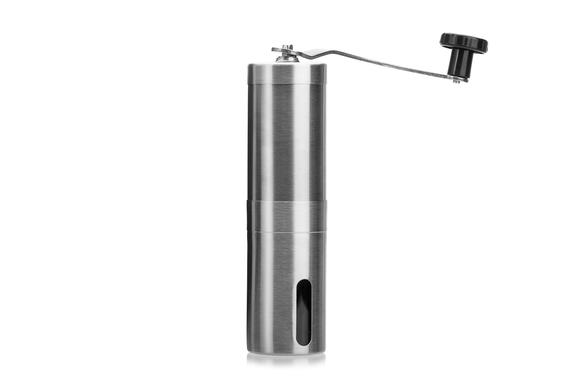
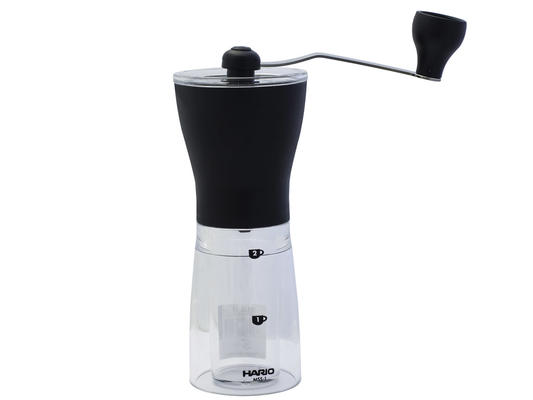
Manual grinders
If you’re a tradition-oriented person and like your coffee prepared the good old-fashioned way, you should reach for a manual coffee grinder. These usually use sharp blades or rough burrs.
Blade grinders have rotating blades that gradually cut your roasted beans into powder. However, you cannot control the coarseness of your final result.
If that’s something you’re unwilling to sacrifice, we recommend getting a stone grinder, also known as a burr grinder – and ideally ceramic. They not only grind your coffee evenly but also make it easy for you to control the coarseness by simply increasing or decreasing the space inside. You can make grinds for espresso, drip or even Turkish coffee.
Manual grinders work slower than electric grinders, which also means that your coffee isn’t heated up during the process – even this can negatively affect the quality. What’s more, they’re smaller and easier to store and travel with wherever a power source may be absent.
Automatic grinders
Undoubtedly more comfortable and, if you really love coffee, much faster. What’s more, you don’t need to worry about bruising your elbow with long-term use. Instead of time-consumingly cranking a handle, all it takes is a press of a button and a few seconds and your coffee is ready. However, the quality strongly depends on whether the mechanism inside is based on blades or burrs. Automatic blade grinders often result in an unevenly ground coffee and hence lower quality. On the other hand, they are easy to clean, maintain and are cheaper. Burr grinders, while pricier, offer even grind and more control over the coarseness. What’s more, if they’re ceramic, there’s no need to worry about dulling or corrosion.
Whichever type of grinder you decide is best for you, you’ll need to regularly maintain it. Ideally, you should clean it after every use, otherwise you’re risking impacting the quality due to the oily residue. But don’t worry, this is usually pretty easy – all you need is a brush or a toothbrush and a few minutes at most.
TIP: And one more thing we want to impart onto you – always grind only as much coffee as you’ll immediately use. Freshly ground coffee has the most aroma and flavor, whereas storing it for a long time leads to a loss of quality.
Coarseness is crucial
Every method of preparing coffee requires different coarseness. When we grind our coffee, we’re increasing the surface of each minuscule particle which allows water to then extract the flavor. The separate elements require different time to be extracted properly. First are fruit acids, which give coffee a refreshing, acidic taste. Then come the sweet and complex layers such as caramel, chocolate or nuts, which are achieved by the sugar molecules and other aromatics. They’re crucial for a balanced aroma. And finally, in the last part, tannins are released – these contribute to the bitter astringency we so love. So be careful of not only how long you let the coffee hydrate, but also how coarse it is.
Finer grinds make the extraction faster while coarser do the opposite. Coarser coffee should equal longer brewing. Extra coarse coffee can be brewed even up to a few hours. On the other hand, finely powdered coffee needs only a few minutes to achieve perfection. A wrong choice of coarseness or brewing time can impact the flavor and make it either too bitter or weak and watery.
But how can you tell?
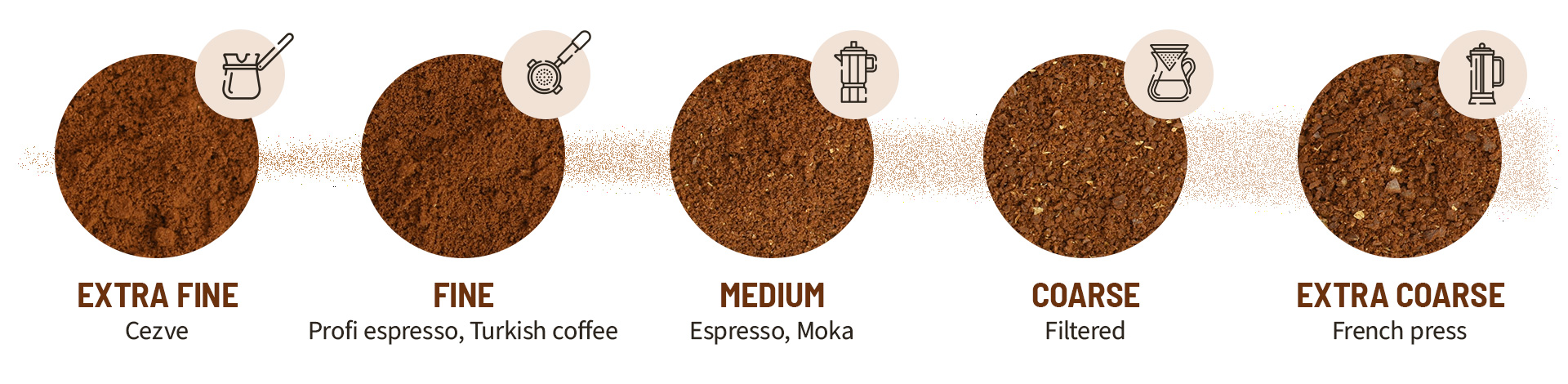
Extra fine
Coffee is reminiscent of a fine powder. This kind is suited for Turkish coffee using cezve and can create an intense flavor almost instantly.
Fine
Fine coffee powder is similar to flour and is the grind of choice for espresso. This method puts the ground coffee under an intense pressure and the coffee is extracted in 20-30 seconds. A coarse grind would cause weak and watery taste.
Medium
Medium grinds have a consistency like a fine sand. These are perfect for mocha, drip coffee and to fill coffee pods.
Coarse
Finally, coarse grinds look most like coarse sea salt. Long extractions, which take up to 4 minutes, require larger particles to prevent excessive bitterness. This is often the grind of choice when using a French press.
Grinding your coffee is one of the most crucial steps in preparing a cup of your favorite beverage. It has the final say on whether you’ll get the perfect drink or rob it of its unique spell. Choosing the wrong coarseness may mean your coffee will lack its refreshing fruity undertone as well as the pleasant bitterness and much more. Make sure you don’t end up with an overtly strong and unsavory liquid nor a dull, watery one.
Still unsure on how to grind your coffee correctly? Visit our website and let our team of professionals help you pick out the perfect coffee and walk you through the process. You can get your own manual grinder or order your coffee pre-ground.